Ready for one of the most challenging card games? Play Crescent Solitaire 100% free with no registration. Test your strategy and clear the crescent now!
✅ Free · ✅ No sign-up · ✅ No download · ✅ Fullscreen · ✅ Mobile-friendly
About Crescent Solitaire
Crescent Solitaire is a card game of the Solitaire family that strays away from the typical layout expected in these games. Like many of this family, the players are expected to organize the cards into foundations following a certain order and for that, they must shift the cards around the piles to get to the ones they need. However, this is where all similarities end.
Crescent Solitaire is not a hard game to play and its rules are fairly simple, but it requires more strategy and planning ahead than most of its counterparts.
Crescent Solitaire rules
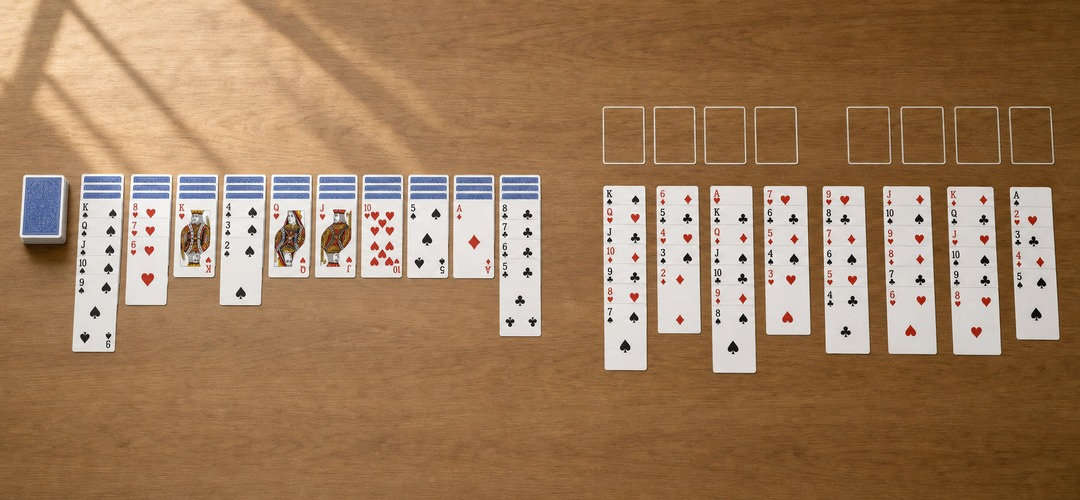
This card game uses two standard 52-card decks. At the center of the table, 4 aces and 4 kings of each suit are laid down to form the 8 foundations.
The foundations with the Kings must be built in descending order and the ones with the Aces in ascending order.
The remaining cards are dealt around the 8 foundations, face forward, creating the shape of an open rectangle: 5 piles on the left and right, united at the top by 6 piles. Only the top card at each pile is visible to the players.
How to play Crescent Solitaire
The goal in this game is to rearrange all the cards in the piles into the 8 foundations. Those starting with the Kings are built in descending order and end with the Aces, while those starting with the Aces must end with the Kings. The cards must always be organized by suit.
The cards on the piles can be moved around to top others with the same suit and with one rank higher or lower. For example, a 7 of Spades can top either a 6 or an 8 of Spades.
The players are allowed to take a peek at the card immediately below the one on top of each pile. In the case of this online Solitaire game, players only have to drag the card slightly to the side to check the one below it.
Empty piles cannot be filled with any cards. Depending on the level of difficulty they would like to challenge, the players can choose between having 3, 6, or 9 shuffles available.
Tips to win at Crescent Solitaire
Take a peek!
Before moving a card to a different pile, drag it a bit to the side to check which one it will uncover. You should also check which one is below the one you were about to move your card into.
For example, if you are thinking about moving a 3 of Diamonds to a 2 of Diamonds, check the cards below both of them. Remember that in Crescent Solitaire you can move either one or the other, as they only have one rank difference.
By taking a look at the possible next cards, you can have a better idea of how the game will progress depending on your choice.
Shift the cards on the foundations
You can move cards between the descending and ascending foundations, as long as you do it in order and by suit.
For example, if you have a descending foundation with K-Q-J-10 and an ascending foundation with A-2-3-4-5-6-7-8-9, you can move the 10 on the first one to top the 9 on the second one (as long as they are from the same suit).
This might be an important strategy depending on the cards you have available on the piles.
If you have a Jack available, for instance, moving the 10 to the ascending sequence will let you remove it right away. However, if you do not have a Jack but instead have a 9, then there is no gain in shifting the cards in the foundations as you can keep them as they are and send the 9 instead to top the 10 on the descending foundation.
Common Mistakes Beginners Make in Crescent Solitaire
Crescent Solitaire looks straightforward at first, but most new players fall into the same traps. Avoiding these mistakes will not guarantee a win — not every deal is winnable — but it will dramatically improve how long you stay in the game and how often you find a path to the foundations.
Moving cards without peeking first
Before moving any card, drag it slightly to the side to reveal the one beneath it. Most beginners skip this step and move cards blindly, only to discover they have buried a card they desperately needed two moves later. Peeking costs nothing and gives you critical information. Make it a habit before every single move.
Using shuffles too early
New players tend to hit the shuffle button the moment they run out of obvious moves. This is a mistake. Before shuffling, scan every pile carefully — there are almost always moves you have missed. Shuffles are a finite and precious resource, especially on Medium and Hard difficulty. Treat each shuffle as a last resort, not a first response.
Ignoring the foundations as a strategic tool
Many beginners think of the foundations as a one-way destination — cards go in and stay in. In Crescent Solitaire, you can move cards between the ascending and descending foundations, and even back onto the tableau, as long as suit and sequence rules are followed. Failing to use this flexibility means missing a large number of valid moves and getting stuck far earlier than necessary.
Clearing tableau piles without a plan
Emptying a pile feels like progress, but in Crescent Solitaire empty spaces cannot be refilled. Once a pile is gone, it is gone permanently. Beginners often clear piles too eagerly, only to realize they have reduced their options for the rest of the game. Before clearing a pile, ask yourself whether losing that slot will hurt you more than the cards you are freeing up will help.
Focusing on one suit and neglecting the others
It is tempting to chase a single suit all the way to the foundation and feel like you are making progress. In practice, this tends to lock up the tableau and leave the other three suits hopelessly buried. A balanced approach — advancing all suits gradually rather than racing one to completion — keeps more options open and prevents the board from grinding to a halt.
Not thinking about both foundations at once
Crescent Solitaire has two types of foundations running simultaneously — ascending from Ace and descending from King. Beginners often focus on one direction and neglect the other, which leads to situations where cards are stuck between two foundations that cannot receive them yet. Keep track of where both sequences stand for each suit at all times.
Forgetting that tableau building goes both ways
Cards on the tableau can be stacked one rank higher or one rank lower, as long as they share the same suit. New players often only move cards in one direction — say, always building downward — and miss perfectly valid upward moves that could unlock a blocked pile. Remember that Kings can also wrap onto Aces and vice versa, opening up even more possibilities.
Crescent Solitaire Variants
Over the years, several variations of Crescent Solitaire have emerged, each adjusting the rules to offer a different level of challenge or a fresh take on the classic layout. Here are the most well-known variants:
Classic Crescent Solitaire
The standard version of the game, played with two 52-card decks. Cards are dealt face-up into 16 tableau piles arranged in a crescent shape around 8 foundation piles. Players get exactly 3 shuffles per game, making every move count. This is considered the most challenging version due to the limited number of redeals.
Open Crescent Solitaire
In Open Crescent, all cards in each tableau pile are dealt face-up and spread out, so every card is visible from the start — not just the top one. This is similar in style to fan games such as La Belle Lucie. Having full visibility of the tableau makes planning significantly easier, though the core rules remain the same. Open Crescent is a good starting point for players new to the game who want to learn card sequencing without the guesswork.
Crescent Four
Crescent Four is identical to Classic Crescent Solitaire with one key difference: players are allowed 4 shuffles instead of 3. That single extra redeal can make a considerable difference when you are one move away from unlocking a key sequence. This variant was described by Comtesse de Blanccoeur and is often recommended for intermediate players who find the standard 3-shuffle limit too restrictive.
La Demi-Lune
La Demi-Lune — French for "the half-moon" — is an alternative name for Crescent Solitaire rather than a distinct variant. The name refers to the crescent or semicircular shape of the tableau layout. You may come across this name in older card game books or European rule sets, but the gameplay is the same as standard Crescent Solitaire.
Frequently Asked Questions about Crescent Solitaire
What is Crescent Solitaire?
Crescent Solitaire is a card game played with two standard 52-card decks (104 cards total). Cards are dealt into 16 tableau piles arranged in a crescent shape around 8 foundation piles. Four foundations start with Aces and are built up to Kings; the other four start with Kings and are built down to Aces. The goal is to move all cards from the tableau onto the foundations.
Is Crescent Solitaire winnable every time?
No, not every deal is winnable. Crescent Solitaire has a relatively low win rate — success depends heavily on the initial card distribution and the choices you make early in the game. Using your shuffles wisely and planning moves ahead significantly improves your chances.
How many shuffles are allowed in Crescent Solitaire?
The number of shuffles depends on the difficulty level you choose. Easy mode allows 9 shuffles, Medium allows 6, and Hard allows only 3. Each shuffle moves the bottom card of every tableau pile to the top, potentially unlocking new moves.
Can you move cards back from the foundations in Crescent Solitaire?
Yes. Unlike many solitaire variants, Crescent Solitaire allows you to move cards from the foundations back onto compatible tableau piles or onto other foundations, as long as the move follows suit and sequence rules. This flexibility is a key part of the strategy.
What happens when a tableau pile is empty in Crescent Solitaire?
Empty tableau piles cannot be refilled. Once a pile is cleared, that space is gone for the rest of the game. This makes clearing piles a double-edged decision — it can open up moves, but you lose a slot on the tableau permanently.
How is Crescent Solitaire different from Klondike?
Crescent Solitaire differs from Klondike in several key ways: it uses two decks instead of one, has 16 tableau piles arranged in a crescent shape, requires building foundations in both ascending and descending order simultaneously, and includes a shuffle mechanic. Klondike is generally more straightforward, while Crescent demands more forward planning.
Can you peek at cards below the top card in Crescent Solitaire?
Yes. You can drag the top card slightly to the side to reveal the card underneath without committing to the move. This is an important tactic — always peek before making a move to avoid blocking yourself further down the pile.