Pyramid Solitaire is a single-player card game where the goal is to clear a pyramid-shaped tableau by removing exposed cards that add up to 13. Unlike Solitaire, where you build foundations by suit, Pyramid Solitaire is based on pairing card values.
You play by looking for uncovered cards in the pyramid, matching pairs such as Queen + Ace, Jack + 2, 10 + 3, or 7 + 6. Kings are worth 13, so they can be removed on their own. If there are no useful moves in the pyramid, you draw cards from the stockpile and try to pair them with available cards. You win when every card in the pyramid has been removed.
What is Pyramid Solitaire?
Pyramid Solitaire is a matching-style solitaire game. The cards are dealt in the shape of a pyramid, and your task is to remove cards by making pairs that total 13. The game is quick to learn because suits do not matter, but it still rewards careful planning.
The game feels very different from classic Klondike Solitaire. In Klondike, you build descending sequences in alternating colors and move cards to foundations by suit. In Pyramid Solitaire, you do not build long sequences. Instead, every decision is about which exposed cards to remove, when to use the stockpile, and how to reveal the cards buried deeper in the pyramid.
This makes Pyramid Solitaire a good choice if you enjoy short puzzle-like card games. It has simple rules, fast rounds and enough strategy to make repeated play interesting.
Pyramid Solitaire setup
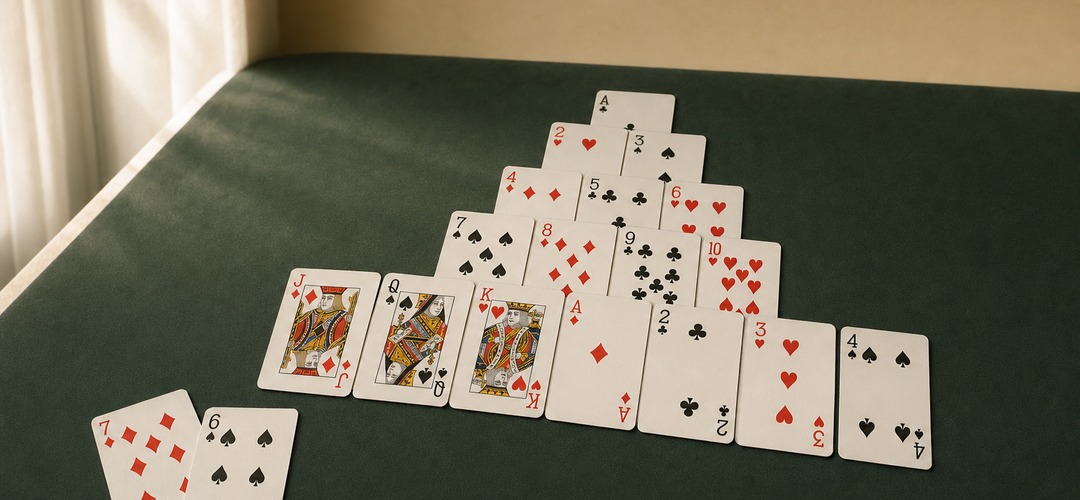
Pyramid Solitaire uses one standard 52-card deck. To set up the game, deal 28 cards face up into a pyramid with seven rows. The first row has one card, the second row has two cards, the third row has three cards, and so on until the seventh row has seven cards.
Each row overlaps the row above it. This matters because a card can only be played when it is fully exposed. At the start of the game, the cards in the bottom row are available, while the cards above them are blocked by overlapping cards.
The remaining 24 cards form the stockpile. These cards are used when you cannot make a useful pair from the pyramid.
| Area | What it means |
|---|---|
| Tableau | The 28 face-up cards arranged in a pyramid |
| Stockpile | The 24 remaining cards placed face down |
| Waste pile | Cards turned over from the stockpile |
| Foundation or discard pile | Where removed pairs are placed |
The pyramid itself is built like this:
| Row | Number of cards |
|---|---|
| 1 | 1 |
| 2 | 2 |
| 3 | 3 |
| 4 | 4 |
| 5 | 5 |
| 6 | 6 |
| 7 | 7 |
Card values in Pyramid Solitaire
The most important rule in Pyramid Solitaire is simple: removable cards must add up to 13. Number cards are worth their face value. Face cards have fixed values, and Kings are special because they already equal 13.
| Card | Value |
|---|---|
| Ace | 1 |
| 2 to 10 | Face value |
| Jack | 11 |
| Queen | 12 |
| King | 13 |
Because a King is worth 13, it does not need another card. If a King is exposed, you can remove it immediately.
Which cards can you pair?
In Pyramid Solitaire, suits and colors do not matter. A 9 of hearts can be paired with a 4 of clubs, a 4 of spades or any other exposed 4. The only thing that matters is whether the two cards add up to 13.
These are all the valid pair combinations:
| Pair | Total |
|---|---|
| Queen + Ace | 13 |
| Jack + 2 | 13 |
| 10 + 3 | 13 |
| 9 + 4 | 13 |
| 8 + 5 | 13 |
| 7 + 6 | 13 |
| King | 13 |
Learning these pairs makes the game much easier. After a few rounds, you will start to recognize matches quickly and spend more time thinking about which move reveals the most useful cards.
How to play Pyramid Solitaire step by step
Once the cards are dealt, the game follows a simple rhythm. Your goal is to remove exposed cards from the pyramid while using the stockpile only when you need help.
- Deal 28 cards into a seven-row pyramid.
- Place the remaining 24 cards face down as the stockpile.
- Look for exposed cards that add up to 13.
- Remove any valid pair and place it in the discard pile.
- Remove exposed Kings on their own.
- When no useful pyramid move is available, turn over a card from the stockpile.
- Use the top card of the waste pile to make a pair with an exposed pyramid card.
- Continue removing pairs and revealing new cards.
- Win by clearing every card from the pyramid.
The key is not just to remove any pair you see. A move is better when it reveals new cards or opens the center of the pyramid. If two pairs are available, check what each one will uncover before choosing.
What does “exposed card” mean?
An exposed card is a card that is not covered by any other card. In Pyramid Solitaire, this is one of the most important rules because you cannot play a card that is still blocked.
At the beginning of the game, only the bottom row of the pyramid is fully exposed. Cards in the rows above are blocked by the cards overlapping them from below. When you remove two cards from a lower row, you may expose one or more cards above them.
For example, if a 10 is partly covered by two cards beneath it, you cannot use that 10 yet. Once both covering cards are removed, the 10 becomes exposed and can be paired with an exposed 3.
This is why clearing the pyramid is a planning puzzle. Sometimes the best move is not the most obvious pair, but the pair that reveals the most important hidden card.
How do you win Pyramid Solitaire?
You win Pyramid Solitaire by clearing all cards from the pyramid. In most versions, you do not need to clear every card from the stockpile or waste pile. The pyramid is the main objective.
You lose when you can no longer remove cards from the pyramid and the stockpile cannot help you create any more pairs. Some versions allow only one pass through the stockpile, while others allow two or three passes. Always check the rules of the version you are playing.
On Solitaire365, the best way to learn the rhythm is to play a few rounds of Pyramid Solitaire after reading the rules. The first games help you understand which pairs are easy to see and which blocked cards require more planning.
Pyramid Solitaire strategy tips
Pyramid Solitaire is partly about luck, because the card order matters, but strategy makes a big difference. These tips will help you make better decisions and win more often.
Remove Kings early
Kings are worth 13, so they can be removed without a pair. If a King is exposed, removing it usually helps because it clears space and may reveal another card. There is rarely a reason to leave an exposed King in place.
Prioritize pyramid cards before stockpile cards
The objective is to clear the pyramid, not the stockpile. If you can make a pair using two exposed pyramid cards, that is often better than using a stockpile card. Removing pyramid cards reveals more cards and gives you more future options.
Look for blocked pairs
Each card value has only one matching value that completes 13. For example, a 9 needs a 4, and a Jack needs a 2. If all the 4s are buried under other cards, your exposed 9s may become harder to use. Scan the pyramid before making moves so you understand which values are trapped.
Clear the middle when possible
Cards in the middle of the pyramid often unlock more of the layout than cards on the edges. Removing edge cards can still be useful, but clearing the center may reveal multiple future options. If you have two possible pairs, choose the one that opens more cards.
Keep both sides balanced
Try not to clear only the left side or only the right side. A lopsided pyramid can leave too many cards blocked on one side, making it harder to finish the game. Balanced clearing usually gives you more flexibility.
Do not rush through the stockpile
The stockpile is helpful, but it is also limited. If you turn over cards too quickly, you may pass a card that you need later. Use the stockpile when the pyramid has no strong moves, but do not rely on it before checking the tableau carefully.
Common mistakes to avoid
The most common mistake in Pyramid Solitaire is removing the first pair you see. A legal move is not always the best move. Before removing cards, ask what the move reveals and whether it helps clear blocked cards.
Another mistake is forgetting that suits do not matter. You do not need to match hearts with hearts or black cards with red cards. Only the values matter. Any exposed cards that add up to 13 can be removed.
Players also overlook Kings. Since Kings can be removed alone, leaving an exposed King on the board usually slows you down. Remove it and use the newly opened space.
Finally, do not assume every deal can be won. Some Pyramid Solitaire games are blocked by the card order. Good strategy improves your chances, but it cannot turn every deal into a guaranteed win.
Pyramid Solitaire vs other solitaire games
Pyramid Solitaire is one of many solitaire games, but its pairing mechanic makes it feel different from sequence-based games.
| Game | Main mechanic | Best for |
|---|---|---|
| Pyramid Solitaire | Pair cards that total 13 | Quick matching puzzles |
| Solitaire | Build foundations by suit | Classic solitaire play |
| TriPeaks Solitaire | Remove cards one rank higher or lower | Fast, casual rounds |
| Golf Solitaire | Clear cards by rank sequence | Simple rhythm and quick turns |
| FreeCell Solitaire | Plan moves using free cells | Strategic problem solving |
If you already know how to play Solitaire, Pyramid Solitaire is a good next game because it changes the challenge completely. Instead of building suits, you think in pairs, values and exposed cards.
Practice Pyramid Solitaire on Solitaire365
The easiest way to understand Pyramid Solitaire is to play a game while the rules are fresh. Start with Pyramid Solitaire, look for pairs that add up to 13, and pay attention to which moves reveal the most cards.
After a few games, try changing your focus. In one game, practice removing Kings quickly. In another, focus on clearing the center. In another, try using the stockpile only after checking every exposed pyramid card. These small habits make the game more strategic and more rewarding.
You can also browse the full collection of Solitaire games to compare Pyramid Solitaire with other variants and find the style of game you enjoy most.
Ready to clear the pyramid?
Pyramid Solitaire is easy to start because the main rule is simple: remove exposed cards that add up to 13. The challenge comes from choosing the right pairs, revealing useful cards and using the stockpile at the right time.
If you are new to the game, begin by memorizing the pair combinations. Then focus on exposed cards, blocked cards and the shape of the pyramid. Once those basics feel natural, each game becomes a quick but satisfying puzzle.