Play Algerian Solitaire free online with no download or sign-up. Also known as Algerian Patience, this challenging two-deck card game asks you to build eight foundations in opposite directions while carefully managing the tableau, reserves, and stock.
Free · No sign-up · No download · Mobile-friendly · Fullscreen · Undo · Hints
What is Algerian Solitaire?
Algerian Solitaire is a challenging solitaire card game played with two standard decks, for a total of 104 cards. It is also widely known as Algerian Patience.
Your goal is to move every card to eight foundation piles. Four foundations are built upward by suit from Ace to King. The other four are built downward by suit from King to Ace. This two-way foundation system is what makes Algerian Solitaire different from familiar games such as Klondike and FreeCell.
You can also arrange cards on the tableau in ascending or descending order by suit. For example, the 7 of hearts can be placed on either the 6 of hearts or the 8 of hearts. Kings and Aces connect, so an Ace can follow a King and a King can follow an Ace when the cards share the same suit.
The rules are easy to understand once you know the layout, but winning requires patience. Every card moved to the wrong position can affect several future moves.
Basic rules and the layout
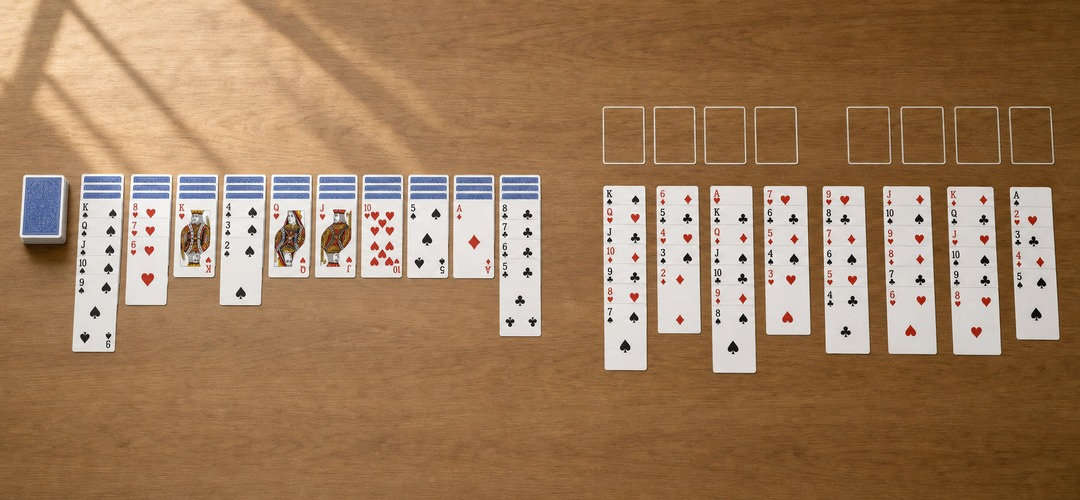
Algerian Solitaire uses several playing areas. Understanding the purpose of each one will make the game much easier to follow.
| Area |
Number |
Purpose |
| Cards |
104 |
Two standard 52-card decks |
| Foundations |
8 |
Four build up by suit and four build down by suit |
| Tableau piles |
8 |
Cards can be built up or down by suit |
| Reserve piles |
6 |
Each begins with six face-up cards |
| Stock |
1 |
Deals additional cards during the game |
The foundations
The eight foundations are divided into two groups:
- Four foundations begin with an Ace and build upward by suit: Ace, 2, 3, and so on through King.
- Four foundations begin with a King and build downward by suit: King, Queen, Jack, and so on through Ace.
The foundations begin empty. As Aces and Kings become available, move them to the correct foundation spaces. Every foundation must contain cards of only one suit.
Cards from matching upward and downward foundations may eventually meet in the middle. Before moving a card to a foundation, check whether you will still need it to organize the tableau or uncover a reserve card.
The tableau
The tableau contains eight piles, each beginning with one face-up card. You can build on these piles upward or downward, but every move must stay within the same suit.
For example:
- The 9 of clubs can be placed on the 8 of clubs.
- The 9 of clubs can also be placed on the 10 of clubs.
- The 9 of clubs cannot be placed on the 8 of spades.
Kings and Aces can wrap around. This means the Ace of diamonds can be placed on the King of diamonds, and the King of diamonds can be placed on the Ace of diamonds.
Only one card can be moved at a time. Even when several cards form a valid sequence, you cannot move the entire sequence together.
The reserve piles
There are six reserve piles, each beginning with six face-up cards. Only the exposed card of each reserve pile is available to play.
Reserve cards can be moved to the foundations or the tableau when they make a legal move. Removing a card exposes the next card in that reserve pile.
You cannot build directly within the reserves or move cards from one reserve pile to another. For this reason, it is important to keep useful destinations open on the tableau.
Empty tableau piles
Any available card can be moved to an empty tableau pile. Empty piles are among the most valuable resources in Algerian Solitaire because they give you another place to reorganize cards.
Try to create at least one empty tableau pile early. Keeping it open can make the difference between reaching a blocked reserve card and running out of moves.
The stock
When you have completed all useful moves, select the stock to deal more cards to the playing area. The new cards may create opportunities, but they can also cover reserve cards you were planning to use.
There is no redeal after the stock has been exhausted. Always inspect the tableau, reserves, and foundations before requesting the next deal.
How to play Algerian Solitaire
The objective is to move all 104 cards to the eight foundations. Follow these steps to start playing:
- Inspect the available cards. Look at the eight tableau cards and the exposed card of each reserve pile. Identify any Aces, Kings, or immediate same-suit moves.
- Start the foundations. Move available Aces and Kings to empty foundation spaces. Remember that four foundations build upward and four build downward.
- Build the tableau by suit. Place cards one rank higher or lower on a card of the same suit. You can change direction within a pile as needed.
- Use King-Ace wrapping. A King and Ace of the same suit are consecutive in the tableau. Use this rule to create moves that would not be possible in most solitaire games.
- Create an empty tableau pile. Move cards away from a short tableau pile whenever you can do so without blocking an important card.
- Expose reserve cards. Use the tableau and foundations to remove playable cards from the reserves. Only the top card of each reserve is available.
- Deal from the stock carefully. Request new cards only after you have exhausted the useful moves already on the board.
- Complete all eight foundations. Continue building four foundations from Ace to King and four from King to Ace until all 104 cards have been cleared.
The most important rule to remember is that tableau cards build by suit, not by alternating color. A red card cannot be placed on another red card simply because the ranks are consecutive. Both cards must have the same suit.
Algerian Solitaire strategy
Algerian Solitaire rewards players who plan several moves ahead. The following strategies will help you keep the board flexible and avoid blocking essential cards.
Open a tableau pile early
An empty tableau pile can hold any available card, making it your most flexible temporary space. Look for a short pile that can be cleared in the opening moves.
Do not fill the empty pile automatically. Before using it, decide which card will create the most new moves. A card from the reserve is often more valuable than a card that is already accessible on the tableau.
Build from the middle ranks
Middle-ranked cards offer more flexibility because they can connect in either direction. A 7 can receive a 6 or an 8 of the same suit, while an Ace or King has fewer immediate options.
When choosing between two legal moves, prefer the move that keeps more ranks accessible. Avoid creating long patterns that look organized but trap the exact card needed to continue them.
Keep both foundation directions moving
It may be tempting to focus only on the foundations that build upward from Aces. However, half of the cards must move to the foundations that build downward from Kings.
Check both sides before sending a card to a foundation. A middle-ranked card may be able to move to either group later in the game. Use the destination that opens the board without blocking the other direction.
Protect access to the reserves
The reserve piles contain a large part of the deck, and only their exposed cards can be played. Your short-term goal should often be to uncover a specific reserve card rather than make the tableau look tidy.
Scan the next visible card in each reserve whenever you make a move. If one reserve has several immediately playable cards, prioritize it. Clearing that pile can create a chain of useful moves.
Use King-Ace wrapping carefully
King-Ace wrapping is powerful, but it can also create circular-looking patterns that do not help you reach the foundations. Use the connection when it exposes a card, creates an empty pile, or prepares a clear foundation move.
Avoid moving a King onto an Ace only because the move is available. First check whether the King should begin a downward foundation or whether the Ace should begin an upward one.
Move cards to the foundations with a purpose
Foundation moves are usually helpful, but they are not always urgent. A card on the tableau may serve as a bridge between two other cards or provide the only useful destination for an exposed reserve card.
Before moving a card to a foundation, ask:
- Does this move expose another card?
- Will I need this card to build on the tableau?
- Can the next foundation card be played soon?
- Does the move help empty a tableau or reserve pile?
If the move does not improve your position, it may be better to leave the card available temporarily.
Delay the stock until the board is exhausted
Every stock deal changes the reserve piles and can cover cards you were about to use. Before selecting the stock, check every exposed card for:
- A foundation move
- An upward tableau move
- A downward tableau move
- A King-Ace wrap-around move
- A move into an empty tableau pile
Once the stock is empty, there is no redeal. Careful timing gives you the best chance of reaching the cards you need.
Plan one suit at a time
When the board becomes complex, focus on one suit and trace its available ranks. Find its Ace, King, and the cards that can connect to them.
This method makes it easier to identify blocked cards and decide which foundation direction should receive the middle ranks. Repeat the scan for each suit before committing to a major move.
How difficult is Algerian Solitaire?
Algerian Solitaire is considered a difficult solitaire game because you must coordinate 104 cards across foundations that move in opposite directions. The tableau can be built both upward and downward, but only within the same suit, and reserve cards must be uncovered in order.
The game also allows only single-card moves. A perfectly arranged sequence cannot be moved as a group, so empty tableau piles are essential for reorganizing cards. Stock deals add further pressure because there is no redeal after the stock is exhausted.
Undo and hints can help you learn the patterns without removing the strategic challenge. If the game offers a solvable deal, that means at least one solution exists, but you still need to discover the correct sequence of moves.
Algerian Solitaire vs. other solitaire games
Algerian Solitaire shares familiar elements with other solitaire games, but its two-way foundations and reserve system create a distinct challenge.
| Game |
Decks |
Tableau building |
Main goal |
Difficulty |
| Algerian Solitaire |
2 |
Up or down by suit |
Build four foundations up and four down |
Complex |
| Klondike Solitaire |
1 |
Down in alternating colors |
Build four foundations from Ace to King |
Moderate |
| Spider Solitaire |
2 |
Down by rank |
Complete same-suit sequences from King to Ace |
Complex |
| FreeCell |
1 |
Down in alternating colors |
Build four foundations using open cells |
Skill-focused |
Algerian Solitaire vs. Klondike
Klondike uses one deck and builds tableau sequences downward in alternating colors. Algerian Solitaire uses two decks and requires cards on the tableau to share the same suit. It also divides its foundations between ascending and descending sequences.
Algerian Solitaire vs. Spider Solitaire
Both games use two decks and reward long-term planning. Spider focuses on assembling complete King-to-Ace sequences on the tableau. Algerian Solitaire asks you to manage reserves while feeding eight foundations in two directions.
Algerian Solitaire vs. FreeCell
FreeCell exposes every card from the beginning and provides four temporary cells. Algerian Solitaire hides access to many cards within the reserves and introduces new cards through the stock. Its empty tableau piles perform some of the same strategic role as FreeCell's open cells.
Algerian Solitaire variants and related games
Several solitaire games use rules or layouts related to Algerian Solitaire. Their names are sometimes used inconsistently, so always check the rules before assuming two versions are identical.
Carthage
Carthage is a related two-deck patience game with its own tableau and dealing rules. It shares the need to organize a large number of cards by suit, but it should be treated as a separate variant rather than another name for Algerian Solitaire.
Tournament
Tournament is another challenging two-deck patience game associated with the same family. Its reserve and tableau mechanics differ, making it a useful next game for players who enjoy restricted access to cards and careful foundation planning.
Algiers Solitaire
Algiers Solitaire is often confused with Algerian Solitaire because of the similar name. Online implementations may use different layouts, stock rules, and movement options. Review the rules shown by the game before playing.
Algerian Solitaire frequently asked questions
Is Algerian Solitaire the same as Algerian Patience?
Yes. Algerian Solitaire and Algerian Patience are commonly used as names for the same two-deck solitaire game. Individual online versions may use slightly different setup or dealing rules, so it is still helpful to review the instructions before starting.
How many decks are used in Algerian Solitaire?
Algerian Solitaire uses two standard 52-card decks, for a total of 104 cards. The cards are distributed among eight tableau piles, six reserve piles, the stock, and eight foundations.
What is the goal of Algerian Solitaire?
The goal is to move all 104 cards to eight foundations. Four foundations build upward by suit from Ace to King, while the other four build downward by suit from King to Ace.
Can cards wrap from King to Ace?
Yes. Kings and Aces are consecutive when building on the tableau. You can place an Ace on a King or a King on an Ace when both cards have the same suit.
Can any card fill an empty tableau pile?
Yes. Any available card can be moved into an empty tableau pile. Empty piles are valuable because they provide temporary space for reorganizing cards and exposing the reserves.
Can you move a sequence of cards?
No. In this version of Algerian Solitaire, cards can only be moved one at a time. A valid sequence must be separated and rebuilt through individual moves.
Is there a redeal in Algerian Solitaire?
No. Once the stock has been exhausted, it cannot be turned over or dealt again. Make every available tableau, reserve, and foundation move before requesting more cards.
Is every Algerian Solitaire game winnable?
Not every random deal is necessarily winnable. If a game is labeled as a solvable or winnable deal, at least one solution has been verified. Undo and hints can help you explore different move sequences.