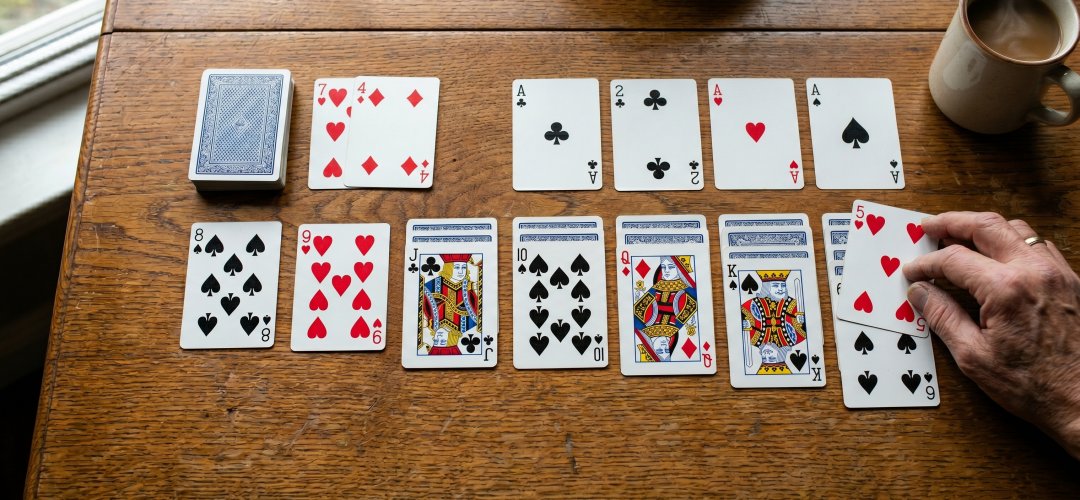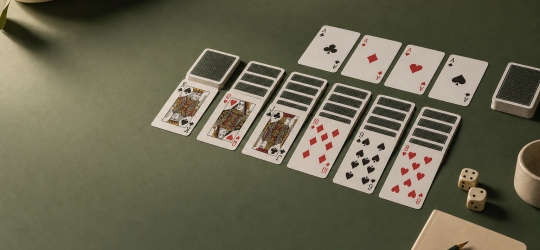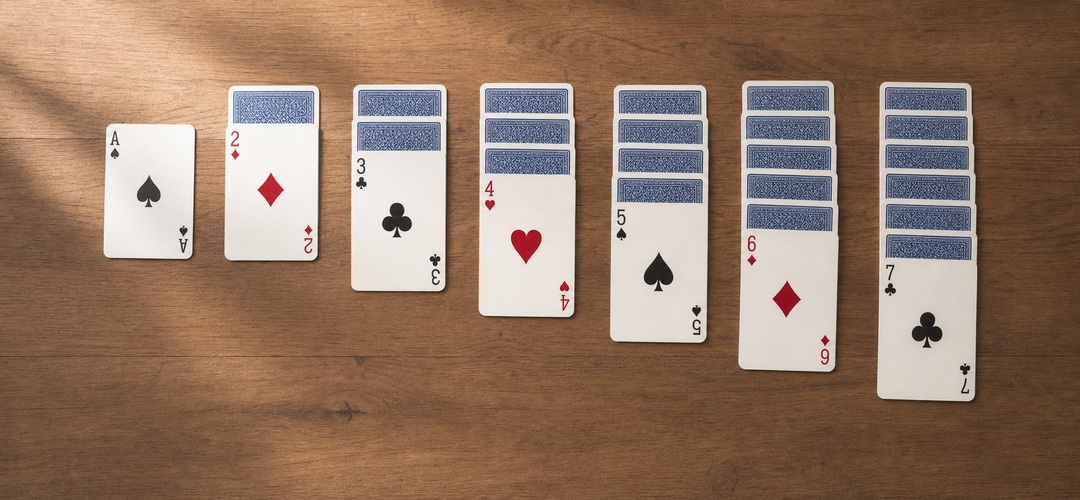
Classic Solitaire, also called Klondike, has seven tableau columns. Many beginners ask how many rows in Solitaire because the cards appear to spread across the table, but the correct term is usually columns. The first column has 1 card, the second has 2 cards, and the pattern continues until the seventh column has 7 cards.
In total, the starting tableau uses 28 cards. The remaining 24 cards stay in the stockpile, while the waste pile and four foundation piles begin empty. Once you understand that simple 1-to-7 pattern, the classic Solitaire layout becomes much easier to recognize and set up correctly.
How Many Rows in Solitaire? The Short Answer
If someone asks how many rows are in Solitaire, the practical answer is usually seven. What they normally mean is: how many piles of cards go across the playing area? In classic Solitaire, there are seven tableau columns across the table.
Each column gets one more card than the column before it. Column 1 has 1 card, column 2 has 2 cards, column 3 has 3 cards, and so on until column 7 has 7 cards. Only the top card of each column is face up at the start of the game.
That means you begin with seven visible cards across the tableau, but the columns are not equal in size. The leftmost column is short, the rightmost column is long, and the whole layout forms a staircase shape.
Why Solitaire Uses Columns, Not Rows
The word “rows” is understandable, especially if you are looking at the layout from left to right. However, classic Solitaire is built around columns because cards are stacked downward in vertical piles. The main playing area is called the tableau.
In the tableau, you move face-up cards between columns, reveal hidden face-down cards, and build descending sequences in alternating colors. For example, a red 6 can be placed on a black 7. A black Queen can be placed on a red King.
So, if you are wondering how many columns in Solitaire, the answer is seven. If you are using the word “rows” casually, you are probably referring to those same seven tableau columns.
Solitaire Row and Column Card Count
The easiest way to check a Solitaire layout is to count the cards in each tableau column. The correct pattern is 1, 2, 3, 4, 5, 6, and 7 cards.
| Tableau column | Total cards | Face-down cards | Face-up cards |
|---|---|---|---|
| 1 | 1 | 0 | 1 |
| 2 | 2 | 1 | 1 |
| 3 | 3 | 2 | 1 |
| 4 | 4 | 3 | 1 |
| 5 | 5 | 4 | 1 |
| 6 | 6 | 5 | 1 |
| 7 | 7 | 6 | 1 |
Altogether, the tableau uses 28 cards. Since classic Solitaire uses a standard 52-card deck, the remaining 24 cards become the stockpile.
The face-up pattern is just as important as the total card count. At the start, every tableau column should have exactly one face-up card on top. All cards underneath should remain face down until you uncover them during play.
If you want the full dealing sequence, use the complete how to set up Solitaire guide. This article focuses on the row, column, and card-count question so you can quickly check whether your layout looks right.
What Should the Solitaire Layout Look Like?
A classic Solitaire layout has four main areas: the tableau, stockpile, waste pile, and foundations. The tableau is the seven-column area where most of the game happens. It usually sits across the lower or middle part of the table.
The stockpile is the face-down deck left after the tableau is dealt. It is usually placed above the tableau on the left. The waste pile sits beside it and starts empty until you begin drawing cards.
The four foundation spaces usually sit above the tableau on the right. These piles also begin empty. During the game, you build each foundation by suit from Ace to King.
If you are playing digitally on Solitaire365, the layout is already prepared for you. You can play Solitaire online without counting cards manually, then use the physical setup rules later if you want to deal the game with a real deck.
How Many Cards Go Across in Solitaire?
Seven card piles go across the tableau in classic Solitaire. These are the same seven columns described above. The bottom visible line can make the layout look like a row of seven face-up cards, but each visible card belongs to a different column.
This is why the question can be confusing. From left to right, you see seven starting piles. From top to bottom, each pile has a different number of cards. Both observations are true, but the standard Solitaire term is still “columns”.
The key numbers are simple:
- 7 tableau columns go across the table.
- 28 cards are dealt into the tableau.
- 7 cards are face up at the start.
- 21 cards are face down in the tableau.
- 24 cards remain in the stockpile.
If your layout does not match those numbers, something probably went wrong during the deal.
Do Other Solitaire Games Have the Same Number of Rows?
No. The seven-column layout belongs to classic Klondike Solitaire. Other solitaire games use different layouts, card counts, and goals, so the answer changes depending on the game.
| Game | Starting layout |
|---|---|
| Solitaire | 7 tableau columns, 28 tableau cards and 24 stockpile cards |
| Spider Solitaire | 10 tableau columns, usually played with two decks |
| FreeCell | 8 tableau columns with all cards face up |
| Pyramid Solitaire | A pyramid-shaped tableau where cards are removed in pairs |
| TriPeaks Solitaire | A three-peak tableau cleared by choosing cards one rank higher or lower |
This matters because “Solitaire” can mean the whole family of single-player card games, but many people use the word to mean classic Klondike. When someone asks how many rows are in Solitaire, they are usually asking about Klondike.
Common Solitaire Layout Mistakes
One common mistake is dealing seven equal piles. In classic Solitaire, the piles should not be equal. They should increase from 1 card on the left to 7 cards on the right.
Another mistake is turning too many cards face up. At the beginning, only the top card in each tableau column should be face up. If every card is face up, you have changed the difficulty and the rules of the game.
Some players also forget to leave room for the foundations. The foundations start empty, but they become essential as soon as an Ace appears. Leave four spaces above the tableau so you have somewhere to build each suit.
Finally, avoid placing the stockpile below the tableau. It is usually clearer to keep the stockpile and waste pile above the columns. This keeps the main play area open and makes the available cards easier to see.
Ready to Check Your Layout?
Classic Solitaire has seven tableau columns, often called rows by beginners. The columns contain 1, 2, 3, 4, 5, 6, and 7 cards, for a total of 28 tableau cards. The remaining 24 cards become the stockpile.
If you only need the quick answer, remember this: seven columns across, one face-up card on each column, and more hidden cards as you move from left to right. That is the classic Solitaire staircase.
To skip the manual deal, you can play Solitaire with the layout already prepared. If you want the full physical-card instructions, read the step-by-step guide on how to set up Solitaire.