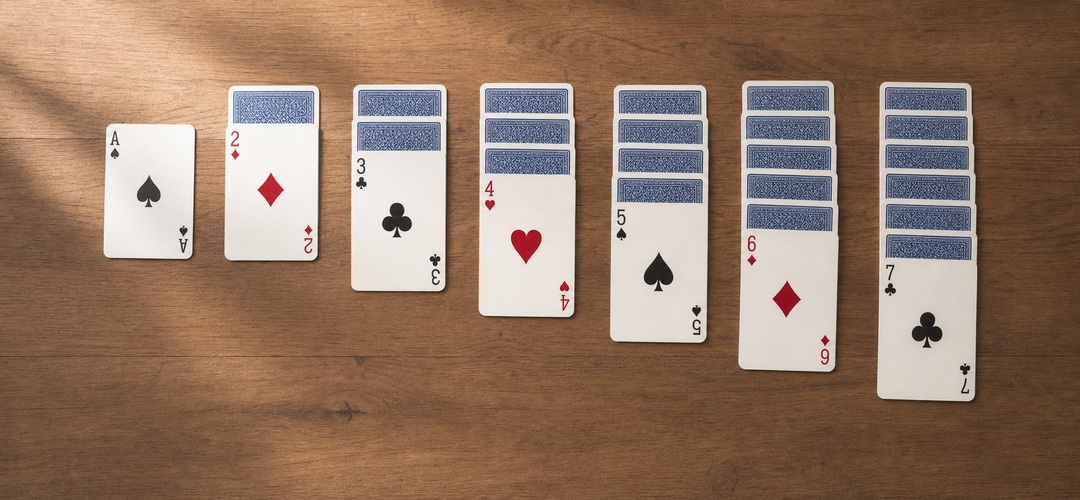
To set up Solitaire, shuffle a standard 52-card deck, deal seven tableau columns from left to right, turn the top card of each column face up, and place the remaining 24 cards in the stockpile. The first column has one card, the second has two cards, the third has three cards, and so on until the seventh column has seven cards.
Only the top card in each tableau column should be face up. The cards underneath stay face down until you uncover them during play. You also need space for a waste pile and four foundation piles, which start empty. If you would rather skip the dealing and start playing immediately, you can play Solitaire with the layout already prepared.
What you need before you set up Solitaire
Classic Solitaire, also called Klondike Solitaire, uses one standard deck of 52 playing cards. Remove the Jokers before you begin, because they are not used in the traditional setup.
You also need a flat surface with enough room for seven tableau columns. A kitchen table, desk or coffee table works well as long as you can spread the cards without overlapping the columns too tightly. Leave extra space above the tableau for the stockpile, waste pile and four foundations.
Before dealing, shuffle the deck well. A good shuffle matters because Solitaire depends on the order of the cards. Once the deck is ready, hold it face down and begin creating the tableau from left to right.
Solitaire card layout
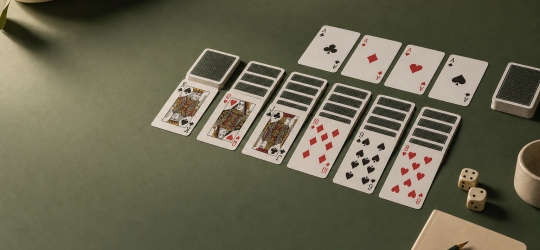
The Solitaire layout has four main areas: the tableau, the stockpile, the waste pile and the foundations. The tableau is the main play area, while the other spaces support drawing cards and building the final suit piles.
| Area | Starting position | Purpose |
|---|---|---|
| Tableau | Seven columns with 28 cards total | Main area where cards are moved and uncovered |
| Stockpile | 24 remaining cards face down | Draw pile used when no tableau move is available |
| Waste pile | Empty at the start | Holds face-up cards drawn from the stockpile |
| Foundations | Four empty spaces | Build each suit from Ace to King |
Think of the layout as a simple map. The seven tableau columns sit across the lower part of the table. The stockpile is usually placed above the tableau on the left. The waste pile sits next to the stockpile, and the four foundation spaces sit above the tableau toward the right.
How to deal Solitaire step by step
Learning how to deal Solitaire is easier when you think of the tableau as a staircase. Each column has one more card than the column before it, and only the top card of each column is face up.
Deal the first row
Start by dealing seven cards from left to right. Place the first card face up in column one. Place the next six cards face down in columns two through seven.
At this point, you have seven columns started. Only the first column has a face-up card.
Start the second column
Now begin again on the second column. Place one card face up on column two. Then deal one face-down card on each column to the right, from column three through column seven.
Column one is already complete, so you skip it from now on.
Continue the staircase pattern
Repeat the same pattern, moving one column to the right each time. On the third pass, place a face-up card on column three and face-down cards on columns four through seven. On the fourth pass, place a face-up card on column four and face-down cards on columns five through seven.
Continue until column seven receives its final face-up card. When the tableau is complete, every column should have one face-up card on top and a different number of face-down cards underneath.
Place the stockpile
After dealing the tableau, you will have 24 cards left. Place these cards face down above the tableau on the left. This is the stockpile.
During the game, you draw cards from the stockpile when you cannot make a useful move in the tableau. Depending on the version you play, you may draw one card at a time or three cards at a time.
Leave space for the waste pile and foundations
The waste pile starts empty and usually sits next to the stockpile. When you draw from the stockpile, the card you turn over goes into the waste pile.
The four foundation piles also start empty. These are the spaces where you eventually build each suit from Ace to King. You can leave these spaces above the tableau on the right.
How many cards go in each Solitaire column?
The easiest way to check your Solitaire setup is to count the cards in each column. The first column has one card, and each column after that has one additional card.
| Column | Total cards | Face-down cards | Face-up cards |
|---|---|---|---|
| 1 | 1 | 0 | 1 |
| 2 | 2 | 1 | 1 |
| 3 | 3 | 2 | 1 |
| 4 | 4 | 3 | 1 |
| 5 | 5 | 4 | 1 |
| 6 | 6 | 5 | 1 |
| 7 | 7 | 6 | 1 |
Altogether, the tableau uses 28 cards. The remaining 24 cards become the stockpile. If your numbers do not match this pattern, the setup is not correct yet.
What are the tableau, stockpile, waste pile and foundations?
The names can sound technical at first, but each area has a simple job.
The tableau is the set of seven columns. This is where most of the game happens. You move face-up cards between columns, build descending sequences in alternating colors and uncover face-down cards as you clear the cards above them.
The stockpile is the face-down deck left after the tableau is dealt. You use it when you need more playable cards. If you are playing Turn 1 Solitaire, you draw one card at a time. If you are playing Turn 3 Solitaire, you draw three cards at a time.
The waste pile is where drawn stockpile cards go. Only the top card of the waste pile is available to play. You can move that card to the tableau or to the foundations if it fits.
The foundations are the four suit piles. Each foundation starts with an Ace and builds upward in the same suit: Ace, 2, 3, 4 and so on up to King. You win Solitaire by moving all cards to the foundations.
What to do after the setup is complete
Once the Solitaire setup is finished, look at the seven face-up tableau cards. If any Aces are visible, move them to the foundation spaces. Aces are the base of the foundations, so they are usually safe to move early.
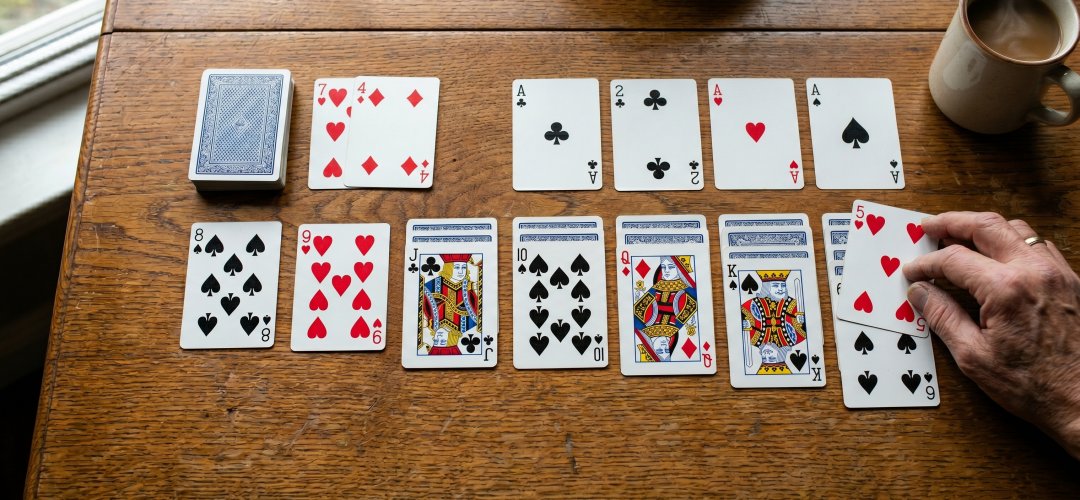
Next, look for tableau moves. Cards in the tableau are built in descending order and alternating colors. For example, a red 6 can be placed on a black 7, and a black Queen can be placed on a red King.
Your early goal is to uncover face-down cards. Every time you move the top face-up card from a column, you reveal the card underneath. More face-up cards mean more choices and a better chance of solving the game.
If no tableau move is available, draw from the stockpile. The card you draw may be playable on a foundation or tableau column. If it is not useful right away, it remains in the waste pile until another move becomes possible.
For a full explanation of the rules after setup, use the complete guide on how to play Solitaire.
Solitaire setup mistakes to avoid
The most common setup mistake is leaving the Jokers in the deck. Classic Solitaire uses 52 cards only, so remove any Jokers, advertising cards or instruction cards before shuffling.
Another common mistake is dealing too many cards face up. In the correct Solitaire layout, only the top card of each tableau column is face up. All cards below the top card should remain face down until uncovered during play.
Players also sometimes forget to leave enough space for the foundations. The foundations start empty, but they become essential as soon as Aces appear. Leave four clear spaces before you begin.
It is also worth placing the stockpile and waste pile above the tableau instead of below it. This keeps the play area organized and makes it easier to see which tableau cards are available.
Finally, do not shuffle the waste pile when you recycle it into the stockpile unless the version you are playing specifically allows that rule. In traditional Klondike, the order of the waste pile matters.
Is the setup different for other Solitaire games?
Yes. “Solitaire” often refers to classic Klondike, but many other solitaire games use different layouts. If you are setting up a different variant, the number of columns, face-up cards and special spaces may change.
| Game | Setup difference | Where to play |
|---|---|---|
| Solitaire | Seven tableau columns, 28 cards dealt, 24 cards in the stockpile | Classic setup |
| Spider Solitaire | Ten columns and a larger tableau, with suits depending on difficulty | Sequence-building challenge |
| FreeCell Solitaire | All cards are face up in eight columns, with four free cells | More strategic planning |
| Pyramid Solitaire | Cards form a pyramid and pairs are removed when they total 13 | Pair-matching puzzle |
| TriPeaks Solitaire | Cards are arranged in three peaks and cleared by rank | Fast, casual rounds |
If you are using a physical deck, make sure you are following the setup for the exact game you want to play. A Klondike Solitaire layout will not work for Spider Solitaire, FreeCell Solitaire or Pyramid Solitaire.
Practice the setup by playing Solitaire online
Once you understand the layout, playing digitally can help you learn faster. On Solitaire365, the tableau, stockpile, waste pile and foundations are set up automatically, so you can focus on the moves instead of worrying about whether the cards are in the right places.
Start with Solitaire if you want the classic Klondike layout. Then explore the full collection of Solitaire games to see how other variants change the setup and the strategy.
If you want a daily reason to practice, try Daily Solitaire. A daily challenge is a good way to reinforce the layout, the basic rules and the habit of looking for moves before drawing from the stockpile.
Ready to deal your first Solitaire layout?
The basic Solitaire setup is simple once you remember the staircase pattern: seven columns, one more card in each column, and only the top card face up. The tableau uses 28 cards, the stockpile uses the remaining 24, and the waste pile and four foundations start empty.
After a few deals, the layout becomes second nature. From there, the real challenge is learning which cards to move, when to draw from the stockpile and how to uncover hidden cards without blocking future moves.